The Product Design Process: A Step-by-Step Guide for Teams
Most product teams can recite the stages of a design process: research, ideate, prototype, test, launch. Fewer can explain why their last project still ran into trouble after following every one of them.
The gap usually isn't a missing step. It's the decisions inside each step: what the team is trying to learn, how much fidelity it needs to learn it, and when the evidence says to change direction. Run as a checklist, a process produces deliverables. Run as a series of decisions, it produces digital products people actually use.
We've been designing and building products for startups and established brands for more than 15 years, and we've launched our own along the way (including Vine and HQ Trivia). Below is how we think about each stage of the product design process — how it shifts from project to project, and who should be in the room. If you're planning a build and want a second set of eyes, we're happy to talk it through.
Quick summary
The product design process is a repeatable way to turn user needs and business goals into a tested product, and it works best as a loop, with teams circling back as they learn.
Most projects move through problem framing, user research, ideation, structure, prototyping and testing, interface design, handoff, and launch.
Each stage exists to answer a specific question, so the right amount of research, fidelity, or testing depends on what the team still needs to learn.
The process should flex with the project, since a new MVP, a redesign, and an enterprise tool each call for a different emphasis.
Design, product, and engineering get better results when they work together from the first stage through launch.
What the Product Design Process Actually Covers
The product design process is the sequence of research, ideation, prototyping, testing, and refinement a team uses to decide what a product should do and how it should work. In digital product design, that spans everything from early market research to the final specs engineers build from.
It sits inside the broader product development process, which also includes engineering, operations, and go-to-market. Design is the part that defines what's being built and why, and on healthy teams it keeps informing the build long after the first release.
It also overlaps with design thinking. Design thinking is a problem-solving mindset (empathize, define, ideate, prototype, test) that works for almost any challenge. A product design process applies that mindset to digital products with real constraints: a budget, a launch window, an existing codebase, and a team that has to maintain whatever gets designed. The goal is a user experience that solves a real problem and holds up once thousands of people start using it.
If you're newer to the discipline itself, our guide to what product design is covers the fundamentals. This piece focuses on how teams actually run the work.
The Product Design Steps, Stage by Stage
The exact process flexes with the product, but most projects we work on move through stages like these. Treat them as a flexible pattern. Teams regularly loop back a stage or two when testing turns up something new.
1. Frame the problem and the business goals
Before anyone opens Figma, the team needs a shared answer to three questions: what problem are we solving, for whom, and how will we know it worked? That means pinning down the product vision, the business goals behind the project, and a few KPIs that reflect real success, like activation, retention, or task completion. Lightweight tools help. A SWOT analysis, early market research, and a competitive landscape analysis show where the product can stand out and where it's exposed. The output is a short brief and a first cut of the product roadmap that everyone has agreed to, which heads off a lot of debate later.
2. Research the people you're designing for
User research turns assumptions into evidence. User interviews, analytics reviews, support-ticket patterns, and audits of existing tools show what people are trying to get done and where they get stuck. From there, teams often build user personas and map the user journey, including the moments outside the product that shape the experience. The goal is a ranked picture of user needs, weighed against what matters to the business. Our guide to remote user research covers a few practical methods when participants are spread out.
3. Explore ideas before committing to one
Ideation works best when it starts deliberately wide. Brainstorming sessions, mind mapping, and quick sketches let the team generate a range of solutions before anyone gets attached to a favorite. Sketching is cheap on purpose: when an idea costs almost nothing to draw, nobody minds throwing it away. Some teams run a structured design sprint here to compress exploration and early validation into one focused stretch. Either way, the stage ends by narrowing to a few directions worth testing.
4. Structure the experience
This is the core of UX design. Information architecture defines how content and features are organized, and user flows map how people move through a task from start to finish. Low-fidelity layouts then sketch each key screen, with the focus on hierarchy and layout; color and type come later. Many structural problems get caught here, because a confusing flow is obvious in a rough layout long before it's buried under visual polish.
5. Prototype and test with real users
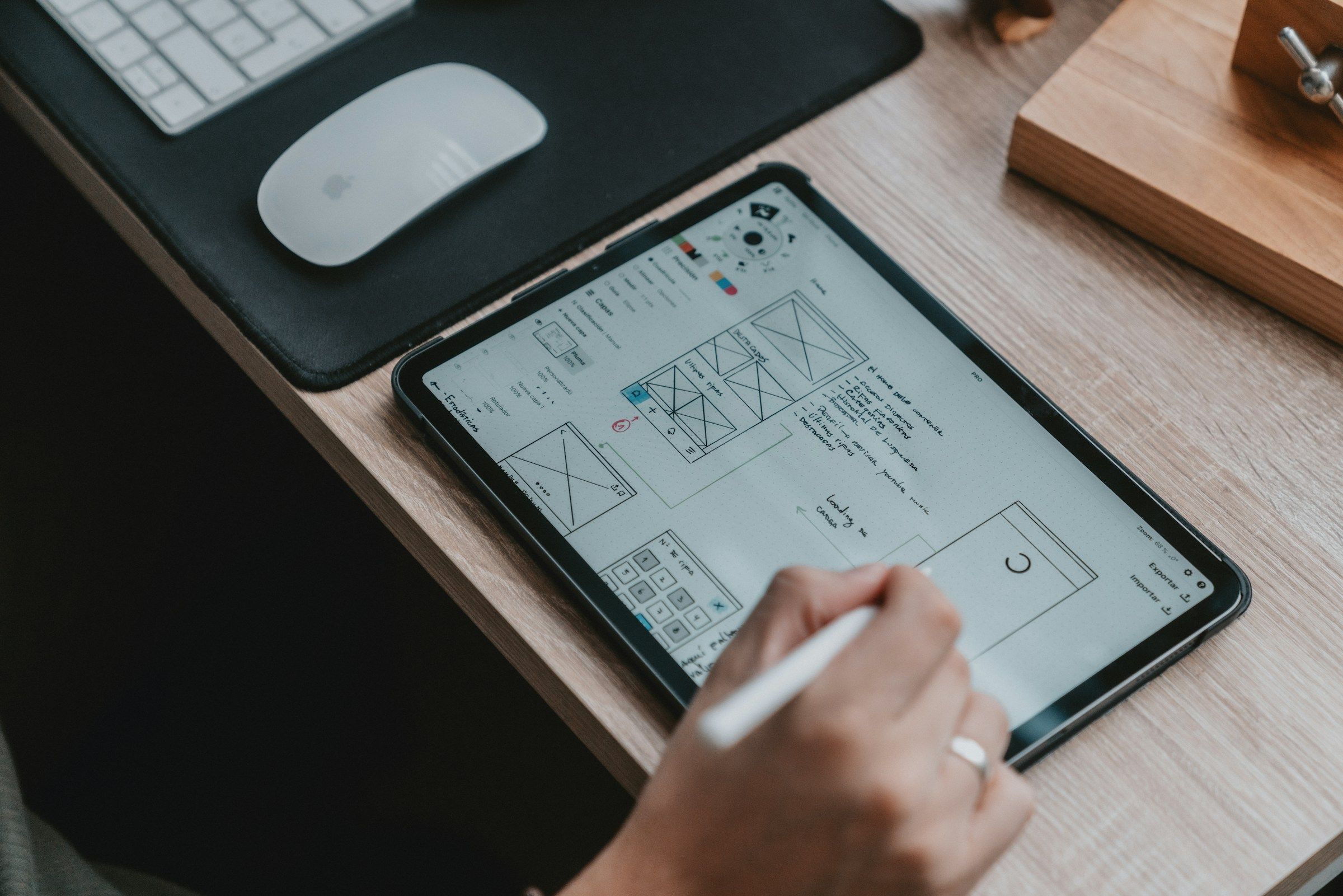
Prototyping is how a team finds out whether an idea works before paying to build it. Early on, low-fidelity prototypes (paper sketches or simple clickable screens) are enough to check whether a flow makes sense. As the direction firms up, interactive prototypes and then high-fidelity prototypes, usually built in Figma, let people use something that looks and behaves like the real thing. Usability testing shows where people hesitate, misread, or give up, while user testing asks a different question: whether the product is valuable to them at all.
Our guide to user testing vs. usability testing covers when to use each. Each round feeds the next iteration, and the loop repeats until the core flows hold up. For help choosing the right level of detail, see our guide to high- vs. low-fidelity prototyping.
6. Design the interface and the system behind it
With the structure validated, UI design and visual design bring the product to life: typography, color, iconography, motion, and how each component responds to a tap or click. Static mockups help teams align on the look before details get wired into a prototype. Just as important is what sits underneath. Design systems and style guides define reusable components and rules so the product stays consistent as it grows and more people work on it. We treat that system as part of the product itself, because it's what keeps the hundredth screen as coherent as the first.
7. Hand off, build, and check the work
Handoff works best as an ongoing conversation. Designers deliver design specifications (annotated screens, interaction states, component documentation), while engineers bring technical specifications and constraints back into the conversation. Many teams build a minimum viable product first: the smallest version that delivers real value and lets the team learn from actual usage. Designers stay involved through the build and through quality assurance, checking that what ships matches what was tested.
8. Launch, measure, and keep improving
A product launch opens a new round of learning. Analytics, support conversations, and A/B testing show how the product performs with real users at real scale. Short feedback loops between those signals and the design team make continuous improvement possible, so each release is shaped by evidence.
What It Looks Like on a Real Project
Our work with Carnegie Hall on its children's music-education sites shows how these stages bend around a real project. Each engagement started with learning about the program behind it, how its needs were changing, and how a digital experience could support it. Musical Explorers introduces students in grades K–2 to musical traditions from around the world, so a world map became the organizing structure, letting the site act as a glossary for each musical community.
When the teams reconvened to build Carnegie Hall Kids, a portal for all of the Hall's children's programs, ideation came first. The Big Human and Carnegie Hall teams brainstormed dozens of quiz concepts together, and Carnegie Hall's stakeholders voted on their top 10. Those picks shaped an expanded quiz format with audio, video, and text interactions. Before launch, we set up a staging site to test the new quizzes with users and see which concepts held up. Carnegie Hall created a Kids brand style guide, which we applied as we designed the quiz engine. Connecting the portal to a headless CMS lets Carnegie Hall's team add and update quizzes without developer help, so the product can keep growing well after handoff.
How the Process Changes With the Project
The stages stay recognizable from project to project. The emphasis shifts. A few situations we see often:
A new product or MVP. Speed of learning matters most. Research and prototyping stay lean and aimed at the riskiest assumptions, and polish waits until the core idea proves itself.
A redesign of an existing product. You already have data, so early stages lean on analytics, support patterns, and an audit of what's live. The risk shifts to change: existing users have habits, and a new design has to earn its way past them.
An enterprise or internal tool. Users are often experts who spend their whole day in the product. Testing focuses on efficiency for repeat tasks, and the design system carries more weight because many teams will build on it.
A narrow, well-defined problem. If the question is one flow or one feature, a focused sprint can cover most of the stages in compressed form.
Sometimes a full process is more than a project needs. A small UI refresh inside an established design system rarely calls for fresh persona work. Part of running the process well is being honest about which stages will actually change the outcome, and putting the effort there. If you're not sure which stages your project actually needs, we can help you sort that out.
Where the Process Usually Breaks Down
Even with every stage on the calendar, a few patterns tend to undermine the work. They're worth watching for because they rarely announce themselves.
Research that never reaches the design. Teams run interviews, write a report, and then design from instinct anyway. Research only earns its cost when specific findings show up in specific decisions, like a reordered flow or a feature that gets cut. If nobody can point to what changed because of the research, it was a formality.
Testing too late to matter. When the first real usability test happens after the interface is polished, the team has already spent its budget for change. Testing rough ideas early feels uncomfortable, but it's the cheapest moment to be wrong. Every iteration after that point gets more expensive.
Losing sight of the full journey. A product can look great one screen at a time and still feel disjointed end to end. Reviewing work against the full user journey catches gaps between steps, inconsistent patterns, and moments where people lose the thread. That end-to-end view is what turns a set of good screens into a good user experience.
Who Should Be Involved
The roster changes as the work moves. Product leads own the vision and the tradeoffs. UX designers lead research, flows, and structure. A UI designer shapes the interface, and on interaction-heavy products, an interaction designer focuses on how each element behaves and responds. Engineers belong in the room early, since technical constraints shape what's worth designing in the first place.
Our projects start by getting strategists, designers, and engineers aligned on the problem, and they keep working side by side through launch. That's how our digital product design and UI/UX design teams operate, and it's a big part of why handoffs stay smooth and fewer surprises turn up late in a build.
Building a Process That Fits Your Team
A good product design process comes from knowing what each stage is for and matching the effort to what the project still needs to learn. Start with a clear problem and real users. Test early, while ideas are cheap to change. Keep design and engineering in the same conversation, and treat launch as the next round of learning.
If you're planning a new product or rethinking one that isn't landing, we'd be glad to walk through how we'd approach it. We'll talk through your goals, constraints, and what success looks like, then map scope and timeline together during the consultation. Start the conversation here.